
Weight-Loss Jabs: What’s Really Changing Beneath the Surface?
Article by Dr. Donald Greig
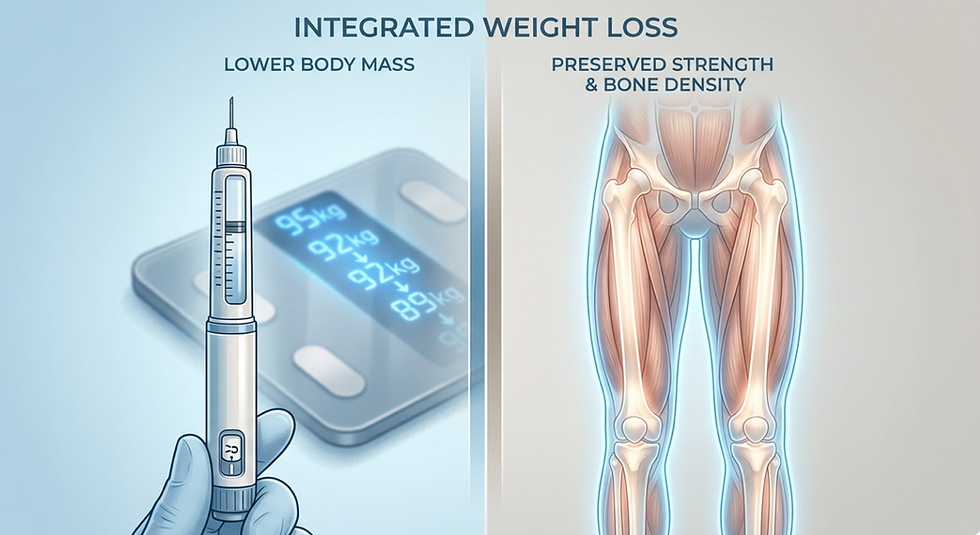
This article was inspired by a recent piece by Eleanor Hayward in The Times Health section (see below for her article), which highlighted concerns that up to a third of weight lost on weight-loss injections may come from muscle and bone, not just fat.
That headline has understandably raised questions.
So what does the clinical evidence actually show — and more importantly, what can we do to protect muscle and bone while losing weight?
First: What Are These “Jabs”?
Medications such as semaglutide (Wegovy/Ozempic) and tirzepatide (Mounjaro) belong to a class called GLP-1 (and dual GLP-1/GIP) receptor agonists.
They work by:
Reducing appetite
Slowing stomach emptying
Increasing feelings of fullness
Helping regulate blood sugar
They are highly effective for weight loss — often producing 10–20% body weight reduction in clinical trials.
However, when we lose weight — by any method — we rarely lose pure fat alone.

What Does the Clinical Evidence Show?
Large clinical trials using body composition analysis (such as DEXA scans) show that:
Approximately 60–75% of weight lost is fat mass
Approximately 25–40% can be lean mass
Lean mass includes:
Muscle
Organs
Body water
Bone (to a smaller degree)
Importantly, this pattern is not unique to GLP-1 medications.Similar proportions are seen with:
Traditional calorie-restricted diets
Rapid weight loss
Bariatric surgery
Because these medications can produce substantial weight loss, the absolute amount of lean mass lost may appear significant if protective measures are not taken.
Why Does Muscle Loss Happen?
Weight loss creates a calorie deficit. If:
Protein intake is insufficient
Resistance exercise is lacking
Weight loss is rapid
The body may break down muscle tissue for energy.
Additional mechanisms include:
1️⃣ Reduced Protein Intake
GLP-1 medications significantly reduce appetite. Many people unintentionally reduce protein intake, which is essential for muscle maintenance.
2️⃣ Lower Anabolic Signalling
Reduced calorie intake decreases muscle-building signals in the body.
3️⃣ Reduced Mechanical Load
As body weight decreases, bones and muscles experience less loading. Bone and muscle respond to stress — when load falls, the stimulus to maintain strength falls too.

What About Bone Density?
Some studies show small reductions in bone mineral density following significant weight loss.
Possible contributing factors:
Reduced mechanical loading
Hormonal shifts (particularly in postmenopausal women)
Changes in calcium and vitamin D balance
Reduced lean muscle mass
The effect appears modest in most patients, but it may be more relevant in:
Older adults
Postmenopausal women
Individuals already at risk of osteoporosis
Is This Dangerous?
Not necessarily — but it is important to manage.
Fat loss brings major health benefits:
✅ Improved blood pressure
✅ Better blood sugar control
✅ Reduced inflammation
✅ Less joint strain
However, excessive muscle loss may contribute to:
Reduced strength
Lower metabolic rate
Fatigue
Increased fall risk (especially in older adults)
The goal is not simply weight loss — it is healthy body composition change.
How to Protect Muscle and Bone
The encouraging news is that we can actively reduce muscle loss.

💪 1. Prioritise Protein
Aim for approximately:
1.0–1.5 grams of protein per kilogram of body weight per day(Individual advice is recommended.)
Include protein at every meal:
Eggs
Fish
Greek yoghurt
Lean meats
Tofu and legumes
Protein stimulates muscle protein synthesis.

🏋️ 2. Resistance Training Is Essential
This is the most powerful protective tool.
At least:
2–3 strength sessions per week
Focus on major muscle groups
Resistance exercise:
Preserves muscle mass
Stimulates bone strength
Improves metabolic health
Without resistance training, muscle loss is more likely.
🚶 3. Don’t Rely on Cardio Alone
Walking and aerobic exercise are excellent for cardiovascular health — but they are not sufficient on their own to preserve muscle mass during weight loss.
Strength training is key.
☀️ 4. Support Bone Health
Ensure:
Adequate calcium intake
Sufficient vitamin D
Regular weight-bearing exercise
Bone density monitoring may be appropriate in higher-risk patients.
🥗 5. Avoid Extreme Calorie Restriction
Very rapid weight loss increases lean mass loss.
A structured, medically supervised programme is safer and more sustainable.
A Balanced Perspective
It is true that some muscle mass is lost during weight reduction with GLP-1 medications.
However:
This is not unique to injections
Much of it is preventable
The overall metabolic benefits of fat loss are substantial
With appropriate nutrition and resistance training, we can shift the balance strongly toward fat loss while preserving strength and bone health.
The Take-Home Message
Weight-loss injections are powerful tools — but they work best as part of a comprehensive plan that includes:
✅ Adequate protein
✅ Regular strength training
✅ Bone health support
✅ Ongoing medical supervision
Healthy weight loss should leave you healthier and stronger — not frailer.
If you are using, or considering, these medications and would like guidance on preserving muscle and bone health, please speak with us.
Disclaimer: This newsletter is for informational purposes only and does not constitute medical advice. Always consult your healthcare provider for any medical concerns.
Third of weight shed after jabs ‘is lost from muscle and bones’
Article by Eleanor Hayward

One third of the weight lost by people using drugs such as Wegovy and Mounjaro comes from muscle and bone, instead of fat, a study has found.
Researchers said that anyone using weight-loss jabs should also do strength training or they faced a heightened risk of frailty, fractures and osteoporosis in old age.
The study, published at the European Congress on Obesity in Istanbul, found that for people who used exercise and diet control to reduce their size, muscle and bone loss accounted for 14 per cent of the weight they shed, in comparison with 32 per cent for those who used weight-loss jabs.
A team at the University of Copenhagen analysed data from 1,334 people who had lost weight either with jabs, through bariatric surgery or by diet and exercise. Those on jabs or surgery lost about twice as much weight in total as those on diets, but they also lost significantly more muscle mass.
The researchers said that as a result “it is vital to incorporate structured exercise into all weight-loss approaches to help preserve that mass”.
Weight-loss jabs are taken by two million people in Britain, and experts have raised fears that too many use them as a “quick fix” without also overhauling their lifestyle and exercise routines.
The study’s authors warned that people who lost a significant amount of muscle were at heightened risk of regaining the weight once they stopped using the drugs, because muscle is “more metabolically active” than fat. The study added that “loss of muscle and bone mass can impair physical function and metabolic health”.
Weight-loss jabs have been shown to cut the risk of a vast number of health conditions, including heart attacks, strokes and kidney disease. However, data from trials of semaglutide, sold under the brand names Ozempic and Wegovy, shows some risks, particularly of certain fractures linked to frailty.
Women over the age of 75 were eight times more likely to be hospitalised with hip fractures and ten times more likely to be hospitalised with pelvic fractures when on weight-loss jabs, compared with placebos, according to an international trial of 17,600 people
Professor Donna Ryan, of Pennington Biomedical Research Center in the US, who has led trials of weight-loss jabs, said that loss of lean mass due to weight-loss jabs could lead to “osteoporosis, frailty and fractures from falling”.
Ryan advised that everyone taking weight-loss jabs, whatever their age, should do exercise to help to maintain muscle mass. She said: “We really need to be promoting exercise. You need to be physically active. When you’re losing a lot of weight, the way to protect your muscles and bones is to do resistance training.”
Despite the risks, medical experts say that overall weight-loss jabs will have vast benefits for public health by cutting obesity-related problems such as heart disease, type 2 diabetes and cancer.
A separate study published on Wednesday, led by Imperial College London, found that obesity rates around the world were levelling off or beginning to fall — a trend that it predicted weight-loss jabs would accelerate.
The research, published in the journal Nature, analysed obesity rates in 200 countries between 1980 and 2024. In Britain, obesity began to plateau in children around the year 2000, and adult rates of obesity began to slow down a decade later. However, the UK remains in the top ten countries for highest obesity levels.
In other countries, including Japan, France and Portugal, obesity levels have started to fall.
Possible reasons include public health policies to tackle child obesity, as well as wealthier populations becoming more health conscious.
Professor Majid Ezzati, the lead researcher, said the impact of weight-loss jabs so far would not have been big enough to have reduced overall obesity rates, but “going forward, they could be a game-changer”.
Professor Jason Halford, a former president of the European Association for the Study of Obesity, said weight-loss jabs “should accelerate” progress towards reducing obesity rates, provided people could access treatment. At present only 1 per cent of eligible patients around the world are able to access weight-loss drugs.
Halford said: “We will see overall [obesity] rates coming down but, because most people are getting it privately, what we will see is differences in rates among different social classes actually increasing.”
Disclaimer: This newsletter is for informational purposes only and does not constitute medical advice. Always consult your healthcare provider for any medical concerns.


Comments